How to Make Money on Pinterest in 2026 (7 Methods With Real Numbers)
Seven ways to make money on Pinterest in 2026 with realistic income ranges, time investment per method, and which ones genuinely work for new accounts versus established creators.
Disclosure: Some links below are affiliate links — if you click and buy, we may earn a small commission at no extra cost to you. We only recommend tools we've actually used. Read our full disclosure.
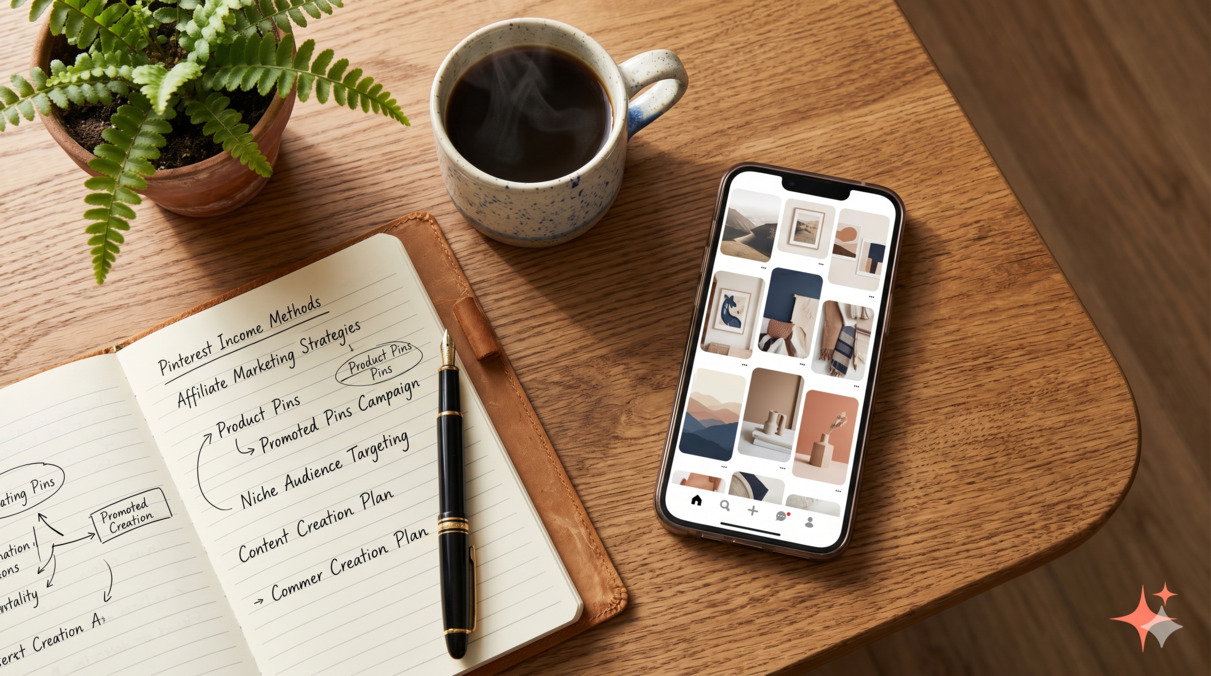
If you've researched making money on Pinterest, you've probably noticed the conflict between Pinterest course-seller marketing ("$10,000/month from Pinterest in 90 days!") and skeptical Reddit threads ("I've been pinning for a year and earned $40"). Both pictures are wrong, but in opposite directions.
This article is the version that emerged from 18 months of running our six faceless Pinterest accounts at the archive plus tracking what's actually working for the people in our network. T.V. handles Pinterest at the archive; the data below comes from real accounts, real testing, and the income that actually showed up versus the income that was promised.
For the broader Pinterest income system (the strategic view across niche selection, account setup, and monetisation), see our Pinterest Income System reading path. For the article-level execution playbook on faceless setup, How to start a faceless Pinterest account is the pillar piece. For the "Pinterest vs Instagram" decision, our platform comparison covers the structural tradeoffs.
This article is the broad "what are the actual methods and how much do they pay" entry point.
Why most Pinterest income advice is wrong
A few patterns worth naming before we get to the methods:
Course-seller compression. Most Pinterest "make money" courses are sold by people whose income is from selling courses, not from Pinterest. The marketing necessarily compresses timelines and overstates results because the alternative is admitting the path is slow.
Survivorship bias in case studies. The "I made $5,000/month from Pinterest" stories you see online are almost always from accounts that survived their first 6-12 months and grew. The vast majority of accounts that started in the same window quit before reaching meaningful income, and you don't see them in case studies.
Confusion between traffic and revenue. "10,000 monthly Pinterest viewers" sounds impressive but doesn't directly translate to income. The same 10,000 viewers can produce $20/month or $500/month depending on what monetisation method you've layered on top.
Outdated 2019-2021 advice. Pinterest's algorithm changed meaningfully in 2022-2023. Methods that worked then (mass-pinning, follower-growth tactics, group boards as primary distribution) work less well or not at all now. Most ranking content on this topic hasn't been updated.
The framework below is what's actually working in 2026.
The two methods that consistently work
These are the methods we'd recommend most new creators focus on. The data is consistent across our six niches and most external case studies we've tracked.
Method 1: Blog routing (Pinterest → blog → affiliate + ad revenue)
The dominant Pinterest income model in 2026. The flow: Pinterest pins drive traffic to your blog, the blog monetises through affiliate links and display advertising, the income stacks across multiple revenue streams.
Why it works: every layer compounds. Pinterest pins generate evergreen traffic for months or years. Blog content ranks in Google over time, adding search traffic on top of Pinterest traffic. Affiliate links and ad revenue both scale with traffic. The model has a long ramp but very durable economics once it's working.
Realistic income trajectory for a creator publishing consistently:
- Months 1-6: $0-100/month (blog needs traffic before monetisation works)
- Months 6-12: $100-800/month (Pinterest traffic compounds, first ad revenue threshold reached)
- Months 12-18: $500-2,500/month (multiple income streams stacked)
- Year 2+: $1,500-8,000/month for healthy accounts; significantly higher for top performers
The required investment: a blog (domain, hosting, basic theme — $10-30/month), consistent content publishing (2-4 articles per week for the first 6 months), and Pinterest distribution work. The combined time investment is 8-15 hours/week for the first 12 months.
For the execution layer, How to make money blogging covers the blogging side and How to start a faceless Pinterest account covers the Pinterest side. They're designed to work together.
Method 2: Digital product sales (Pinterest → your own product)
The second method that works consistently is using Pinterest distribution to drive sales of your own digital products: ebooks, templates, courses, printables (when truly differentiated), or paid memberships.
Why it works: digital products have margin structures (often 85-95% gross margin) that affiliate marketing can't match. A creator generating $500/month from affiliate links would generate $1,500-3,000/month from the same traffic if it was directed to a $30 digital product instead.
Realistic income trajectory:
- Months 1-6: $0-200/month (product creation period, first launches)
- Months 6-12: $200-1,500/month (product-market fit, launch optimisation)
- Year 2+: $1,000-10,000/month for products that find genuine market fit
The catch: digital product income requires creating something genuinely useful and finding the right audience for it. Most first attempts at digital products underperform because the product doesn't match what audiences actually want to buy. The path that works is iterative — small initial product, gather feedback, improve or replace based on what sells.
The combination: many of the highest-earning Pinterest accounts we've watched combine both methods — blog routing as the primary engine, with digital products as a higher-margin secondary stream. Once a blog is generating consistent traffic, layering a digital product on top can 2-4x revenue without proportional traffic increases.
The three methods that sometimes work
These methods produce income for some creators and not for others. The variance is structural, not just luck.
Method 3: Direct affiliate linking on Pinterest
Pinterest officially allows direct affiliate linking (with proper FTC disclosure), and some creators monetise this way successfully. The constraints:
- Some affiliate programs prohibit direct Pinterest linking in their terms (Amazon Associates is the major one)
- Direct affiliate links are commission-only — no display ad revenue, no email-list building, no SEO compounding
- Pinterest's algorithm can deprioritise pins that lead directly to retail platforms versus pins leading to content
When it works: in niches where the affiliate programs you'd use (Awin, Impact, ShareASale, mid-market direct programs) explicitly permit Pinterest linking AND your audience converts well on direct purchase intent. Common niches that fit: home decor, fashion, beauty, kitchen products.
When it doesn't: when Amazon-heavy product mix matters (you can't directly link Amazon affiliate URLs from Pinterest per the program terms), or when your audience needs more context before purchasing than a single pin provides.
Realistic income: $50-1,200/month for accounts that get this method working. Lower variance than blog routing but lower ceiling — direct affiliate Pinterest accounts rarely scale past $1,500/month.
For the deeper version, see our Pinterest affiliate marketing guide which walks through direct vs blog routing in detail.
Method 4: Etsy printables driven by Pinterest traffic
A specific application of the broader product-creator pattern. Pin → Etsy listing for digital printable (planner, art print, template, organiser).
The 2026 reality: this method worked very well in 2020-2022 when the supply of AI-generated and quickly-produced printables was thin. It's now meaningfully saturated. The narrow niches where it still works require either genuine design skill or specific market expertise (not "make 50 generic planners with Canva and AI imagery").
Realistic income: $50-400/month in saturated niches, $400-2,000/month in narrow well-chosen niches with genuine differentiation.
The catch: most beginners enter this method via the saturated end (generic printables in well-known niches). The narrow viable end requires either design talent or specific niche knowledge, neither of which is automatable.
Method 5: Brand sponsorships and partnerships
Pinterest's Creator Hub and external sponsorship marketplaces (AspireIQ, Statusphere, Pinterest's own creator programs) connect Pinterest creators with brands willing to pay for sponsored content.
Realistic threshold: brands generally don't engage with Pinterest accounts under 50,000 monthly viewers. Most engagement happens at 100,000+ monthly viewers. Below that, you're pursuing sponsorship without enough audience to justify it.
Realistic income for accounts that reach the threshold: $200-2,000 per sponsored campaign, with most successful creators landing 1-4 campaigns per quarter.
The catch: building to 50K+ monthly viewers takes 9-18 months for most accounts. Sponsorships are a year-2 income stream, not a year-1 one. Treating it as a primary near-term goal is usually a mistake.
The two methods that mostly don't work
These get mentioned in Pinterest income content but consistently underdeliver.
Method 6: Pinterest's Creator Fund equivalents
Pinterest has rolled out various creator-payment programs over 2022-2026 (Creator Rewards, sponsored idea pin programs, etc.). Payouts have consistently been low: typical creators report $0.30-1.50 per 1,000 impressions, well below what those impressions would generate via blog routing or product sales.
The right framing: Pinterest's direct payout programs are supplemental, not primary income. Don't optimise for them at the expense of the methods that actually pay.
Method 7: "Constant pinning" approaches that confuse activity with income
The pattern: pin 50-100 times daily, manage 30 group boards, post idea pins constantly. The marketing implies high activity equals high income. The reality is that activity above a certain threshold doesn't help, and very high activity often hurts (Pinterest's algorithm penalises spam patterns).
The pinning cadence that works in 2026: 5-15 fresh pins per week, with consistent niche focus and brand consistency. Anyone telling you to pin 50 times daily is repeating advice from 2018-2020 that isn't relevant to the current algorithm.
Realistic timeline for a new account
Pulling everything together. For a creator starting a new Pinterest account in 2026 with the goal of building income, the honest timeline:
| Stage | Timeline | Realistic monthly income |
|---|---|---|
| Account setup, first 30 pins | Days 1-30 | $0 |
| First account traction | Months 2-3 | $0-50 |
| First income trickling in | Months 3-6 | $50-300 |
| Multiple methods stacking | Months 6-12 | $300-1,500 |
| Established account | Year 1-2 | $1,000-5,000 |
| Top performers in good niches | Year 2+ | $5,000-30,000+ |
The pattern that consistently fails: quitting before month 9-12 because income at month 6 felt insufficient. Most accounts at month 6 producing $200-400/month would have reached $1,000-2,500/month by month 18 if they'd continued. Quitting early is the single biggest reason Pinterest accounts don't reach meaningful income.
The pattern that consistently succeeds: picking the right niche (see our niche selection guide), executing one or two methods consistently rather than chasing all seven, and committing to 12-18 months of consistent work before evaluating whether the path is working.
What a starter stack looks like
For a new creator, here's the income-method stack we'd recommend:
Months 1-3 — focus exclusively on account setup and content. No monetisation pressure yet.
Months 3-9 — add blog routing as the primary method. Drive Pinterest traffic to a small blog with affiliate links and ad placeholders. Income builds slowly but compounds.
Months 9-18 — once blog routing is producing consistent income, layer a single digital product on top. Start small ($15-30 product), iterate based on what sells.
Year 2+ — evaluate whether to add direct affiliate linking, expand digital products, or pursue sponsorships. The right additions depend on what the first 12-18 months revealed about your audience and niche.
This stack is significantly slower than course-seller marketing suggests but matches what we've actually watched succeed.
What we'd specifically not recommend
A few things that get marketed for Pinterest income and consistently underdeliver:
Pinterest "training programs" priced at $500-3,000. The information they sell is mostly publicly available. The course-seller economy in Pinterest specifically is one of the more saturated and least value-aligned in the broader online-business space.
Pinterest "viral templates" packs. Pre-designed pin templates rarely outperform templates you build yourself based on the pin design principles. Brand consistency matters more than template quality.
Multi-account empires. Running 5-10 Pinterest accounts simultaneously is occasionally recommended as a scaling tactic. In practice, it spreads attention thin and produces worse results than one well-run account at scale. Top earners almost always have one or two excellent accounts, not many mediocre ones.
"Done-for-you" Pinterest services. If someone offers to run your Pinterest for income share, the math rarely works for either party. The exception: established VA services for businesses that have other income streams and need Pinterest distribution; that's our VA article territory, not personal Pinterest income.
Frequently asked questions
FAQFrequently asked
How much can a new Pinterest account realistically earn in the first year?
Can I make money on Pinterest without a blog?
Is Pinterest still worth it in 2026 with all the AI content?
How many followers do I need to make money on Pinterest?
What's the worst beginner mistake on Pinterest income?
Do I need to pay for paid courses to learn Pinterest?
How long until I should expect my first dollar from Pinterest?
Are Idea Pins worth investing time in?
What to do next
If Pinterest income is the goal, the practical sequence is: pick a niche (the niche selection article is upstream), set up a faceless account (the 30-day setup playbook), focus on blog routing as the primary method (the blogging pillar covers the blog side), and add a digital product around month 9-12.
For the full Pinterest income system in sequence, our Pinterest Income System reading path ties the eight relevant articles together with a 90-day journey.
For the platform-choice decision (Pinterest vs Instagram), our comparison piece covers the structural differences with 18 months of paired-account data.
Drop your email below to get our Faceless Pinterest Niche List — 40 niches we've tested, ranked by competition level and monetisation potential, with one example pin idea per niche. Free, no signup gate beyond email.
How this article was made
Written by The Hustle Archive Team. Tested by T.V.. Fact-checked by M.A.. Originally published May 5, 2026, last updated May 5, 2026. Read our editorial policy and the methodology behind our rankings.
Found an error? Tell us— we update articles within a week.
Free download
40 Faceless Pinterest Niches
Categorised, scannable, with monetisation fit and example pin ideas.
Read next
More from the archive
Pinterest Marketing · 16 min
How to Make Money on Pinterest Without a Blog (5 Methods Tested)
Five ways to make money on Pinterest without running a blog, with realistic income ceilings, the methods that actually work, and the tradeoffs versus the blog-routing approach.
Read more
Pinterest Marketing · 18 min
Pinterest Affiliate Marketing: Complete 2026 Guide
The full guide to Pinterest affiliate marketing in 2026. Direct linking vs blog routing, programs that work, and the niche-by-niche strategy we use.
Read more
Pinterest Marketing · 17 min
Pinterest vs Instagram for Beginners in 2026 (Tested Both for 18 Months)
We ran identical content strategies on Pinterest and Instagram for 18 months across six niches. Here's the honest comparison: traffic, monetization, time investment, and which platform fits which goal.
Read more


