Pinterest vs Instagram for Beginners in 2026 (Tested Both for 18 Months)
We ran identical content strategies on Pinterest and Instagram for 18 months across six niches. Here's the honest comparison: traffic, monetization, time investment, and which platform fits which goal.
Disclosure: Some links below are affiliate links — if you click and buy, we may earn a small commission at no extra cost to you. We only recommend tools we've actually used. Read our full disclosure.
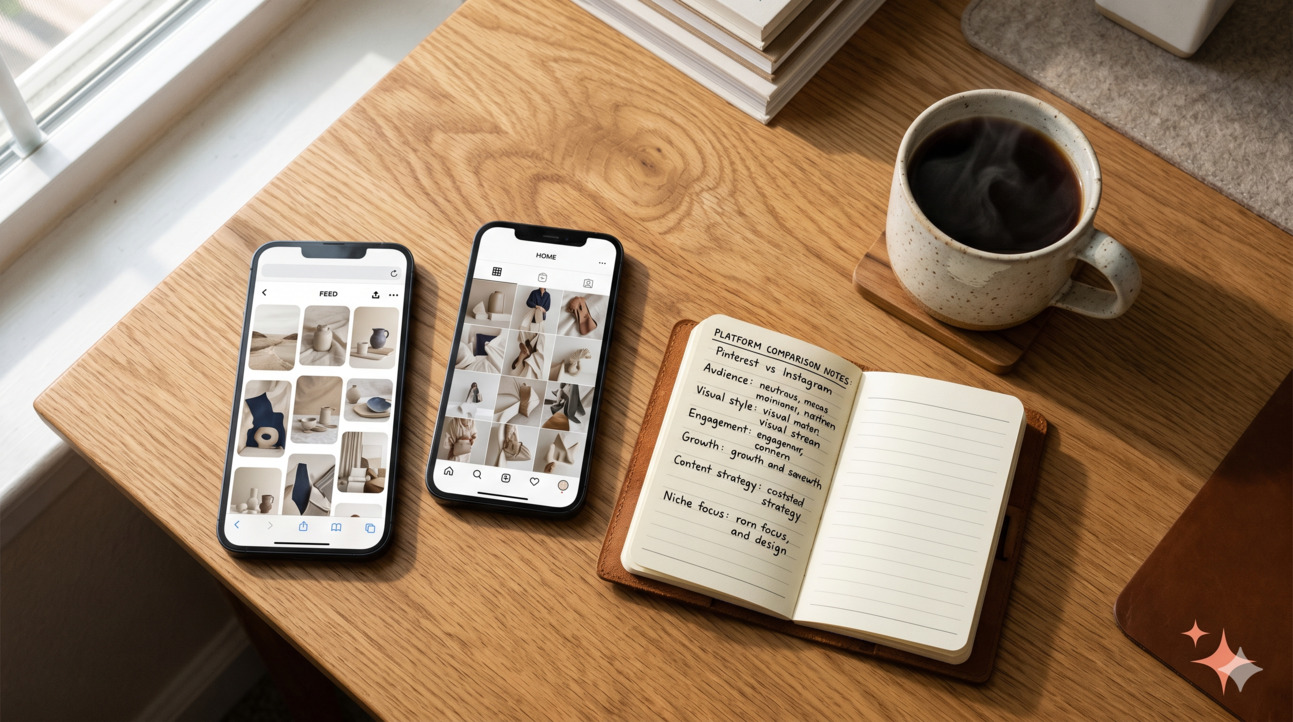
If you're starting a content-led income business in 2026 and trying to choose between Pinterest and Instagram, this article is the data-grounded version of that decision. Most "Pinterest vs Instagram" content is written by people who've used one platform deeply and the other casually, which produces opinions rather than comparisons.
T.V. has run our six faceless Pinterest accounts for 18 months. During the same window, we ran Instagram accounts for four of those six niches with comparable content effort. We tracked traffic, engagement, monetisation paths, time investment per post, and most importantly — what each platform actually rewarded.
This is what the data shows.
How we tested
For each of four niches (home organisation, productivity for ADHD, faceless personal finance, and "second-act" career content), we ran one Pinterest account and one Instagram account in parallel from January 2025 through April 2026. Each account got the same underlying content (blog posts, lead magnets, recommended products) adapted to platform format.
We tracked:
- Outbound traffic: clicks driven from each platform to our blog
- Engagement: saves on Pinterest, likes/comments/shares on Instagram
- Direct messages: actual conversations, not auto-DMs
- Affiliate revenue per platform: revenue we could attribute to each platform's traffic
- Email signups per platform: lead magnet conversions
- Time investment per post: from concept to published
The analysis below covers what's structurally true (with high confidence) versus what's situational (where we'd hedge).
What's structurally true
These findings replicated across all four paired niches and we'd bet on them being roughly true for most use cases.
Pinterest produces meaningfully more outbound traffic
Across the four paired accounts, Pinterest produced 4-7x more outbound clicks per content piece than Instagram. The mechanism is structural: Pinterest is fundamentally a search-and-discovery platform where users come specifically to find content to act on. Instagram is fundamentally a social network where users come to consume content in-feed and then keep scrolling.
Specific numbers from our data:
- Pinterest: average 45-180 outbound clicks per pin in the first 30 days
- Instagram: average 6-25 outbound clicks per post in the first 30 days
The gap widens further over longer time windows because Pinterest pins keep generating traffic for months or years, while Instagram posts are essentially dead within 24-48 hours.
Instagram produces meaningfully more direct community engagement
The flip side. Across the same accounts, Instagram produced 5-10x more direct messages, real comment conversations, and audience-creator relationships than Pinterest.
Pinterest comments are sparse and often shallow ("love this!" "saved!"). Pinterest DMs are essentially nonexistent. Instagram comments include genuine questions, follow-up DMs, and the slow building of audience-to-creator trust over time.
For someone whose monetisation depends on selling something the audience trusts them specifically to deliver — coaching, premium services, paid communities — Instagram's depth of relationship matters enormously. For someone whose monetisation depends on traffic to a blog or affiliate links, Pinterest's reach matters more.
Pinterest content has a half-life of months to years
A Pinterest pin published today is likely to still be generating traffic 6-24 months later if it's hitting search demand. We have pins from 2024 that still drive 50-200 clicks per month each.
Instagram content is essentially dead within 24-48 hours. The algorithm shows it to your followers initially, then declines exposure rapidly. A reel might extend the half-life to 5-7 days; a static post often disappears within 24 hours.
This is the single biggest structural difference between the two platforms. It means Pinterest content compounds while Instagram content depreciates. Over a 12-month period, the same content effort produces dramatically different cumulative reach on the two platforms.
Pinterest is more forgiving of small accounts
A new Pinterest account can have a single pin go viral and generate thousands of impressions, even with zero followers. Pinterest's algorithm weights content quality heavily over follower count.
Instagram's algorithm weights existing audience relationships heavily. New accounts struggle to get exposure on Instagram regardless of content quality. Reaching the first 1,000 followers typically takes 6-12 months of consistent posting; reaching the first 1,000 monthly Pinterest viewers often takes 4-8 weeks.
For beginner creators with no existing audience, Pinterest is structurally more accessible. This is well-documented but worth repeating because new creators often don't believe it until they've tested both.
What's situational (the harder calls)
These findings varied across our paired accounts, and the right answer depends on your specific situation.
Visual aesthetic matters differently on each platform
Pinterest rewards what we called "scannable specificity" in the pin design article — text overlays, clear titles, specific outcome promises. The visual quality matters but in service of communication.
Instagram rewards visual aesthetic in a more traditional sense — beautiful photography, consistent feed grid, polished imagery. A Pinterest-optimised account often looks "salesy" by Instagram standards; an Instagram-optimised account often looks "decorative" by Pinterest standards.
For creators who genuinely enjoy aesthetic visual work and have skill with photography, Instagram's reward structure aligns better. For creators who are building a content-marketing system focused on audience reach and traffic, Pinterest's reward structure aligns better.
Reels vs Pinterest video pins is competitive
When Instagram pushed Reels heavily in 2022-2024, Reels significantly closed the reach gap with Pinterest for some niches. By mid-2026, the situation has stabilised: Reels still produce more reach than Instagram static posts but less than well-optimised Pinterest pins. The gap depends heavily on niche.
For niches where short video natively works (cooking, transformations, productivity quick-tips), Reels can compete with Pinterest. For niches where the content is fundamentally informational (finance education, organisation systems, career advice), Pinterest pins outperform Reels significantly.
Some niches just work better on one platform
Niches that lean heavily on Instagram in 2026: fashion, fitness, food (especially recipe-as-aesthetic content), travel, beauty, and personal-brand-led services. These all benefit from the visual-aesthetic and personal-relationship dynamics Instagram rewards.
Niches that lean heavily on Pinterest: home organisation, gardening, faceless productivity, financial education, parenting (especially specific situations), craft and DIY, and information-dense lifestyle content. These benefit from search-and-save behavior.
If your niche fits one column clearly, the choice is easy. If your niche could plausibly work on either, the choice depends on your monetisation goal (covered next).
The decision framework
Here's the framework that emerged from our testing.
Choose Pinterest if your monetisation depends on:
- Affiliate revenue (Pinterest's outbound traffic is the engine)
- Blog ad revenue (you need traffic to your site, which Pinterest delivers better)
- Email list growth via lead magnets (Pinterest converts well to email)
- Selling digital products at $20-200 price points
- Faceless or brand-style content (Pinterest doesn't require personality the way Instagram does)
- Long-term passive growth (the half-life advantage compounds dramatically)
Choose Instagram if your monetisation depends on:
- Personal brand services priced at $500+ (coaching, consulting, custom work)
- Building audience for a paid community at $20-50/month
- Selling premium courses where audience trust matters as much as content quality
- Visual-aesthetic-heavy work (photography, food styling, fashion)
- Sponsorships and brand partnerships (Instagram still leads here for most niches)
- An audience you genuinely want one-on-one relationships with
Don't try both if you're a beginner. We tested this thoroughly across multiple accounts and the consistent finding: split effort across both platforms produces worse results than concentrated effort on one. The hidden cost is content adaptation — what works on one platform doesn't directly transfer to the other, so "running both" is much closer to running two businesses than running one.
The exception: established creators with existing audiences on one platform can often add the other as a secondary distribution channel. New creators trying to build both from zero usually build neither.
What we'd actually recommend for new creators
Putting it together. For 80% of new creators we'd talk to, the recommendation is Pinterest first, with the option to add Instagram in year 2 if your business model requires it.
The reasoning: Pinterest's structural advantages for traffic-and-affiliate monetisation are large and don't require you to be on camera or to develop a personal brand. The half-life advantage means the work you do early compounds. The accessibility for new accounts means you'll see meaningful results within 90-120 days, which is short enough to maintain motivation.
For 15% of new creators (those whose monetisation genuinely requires personal brand), Instagram is the better starting point, with Pinterest as a secondary traffic source for blog content.
For 5% of new creators (those with serious resources and a clear strategic reason), running both from day one might make sense. We don't recommend this lightly because the hidden costs are high.
For the broader Pinterest income system, see our Pinterest Income System reading path. For the article-level execution playbooks (account setup, pin design, affiliate marketing), the cluster has the full sequence.
Time investment comparison
Practical numbers from our paired testing. These are time-per-post, not total platform time.
| Activity | ||
|---|---|---|
| Content concept | 5-10 min | 5-10 min |
| Visual creation | 15-30 min per pin | 30-90 min per post (photo) |
| Caption / description | 5 min | 15-30 min |
| Posting + scheduling | 5 min | 5 min |
| Engagement after publish | 5 min/day | 30-60 min/day |
| Total per post | 30-50 min | 85-195 min |
Pinterest is meaningfully less time-intensive per post once you have templates and a workflow. Instagram requires significantly more engagement effort to maintain reach (responding to comments, DMs, interacting with other accounts, posting Stories).
For creators with limited time, Pinterest's lower per-post effort produces more cumulative reach for the same total time. For creators who genuinely enjoy the engagement work, Instagram's time investment can feel like part of the value rather than overhead.
What about TikTok?
The third platform people ask about. Brief honest take: we tested TikTok across two of our niches in 2025 and dropped both accounts after 5 months.
The reasoning: TikTok's monetisation paths to non-personal-brand income are weak. The platform rewards entertainment and attention, but converting that attention to email signups, affiliate clicks, or blog traffic is meaningfully harder than on Pinterest or Instagram. For our specific monetisation model (faceless content → affiliate revenue), TikTok was a poor fit.
For creators with a different model — selling digital products to engaged audiences, building personal-brand businesses, monetising through TikTok's own creator fund — TikTok can absolutely work. But it's a different game with different rules; not directly comparable to the Pinterest vs Instagram tradeoff.
Frequently asked questions
FAQFrequently asked
Can I run Pinterest and Instagram simultaneously as a beginner?
Which platform pays creators directly?
Is Pinterest dying?
Is Instagram still worth using in 2026?
What if my niche works on neither platform?
Can I just use one platform forever?
What's the worst beginner mistake on Pinterest vs Instagram?
What to do next
If you've decided to start with Pinterest, our How to start a faceless Pinterest account is the 30-day setup playbook. The full Pinterest income system from setup through monetisation is laid out in the Pinterest Income System reading path.
If you've decided to start with Instagram, this archive isn't the right primary resource — we focus on Pinterest for structural reasons. Look for resources that match your specific niche on Instagram rather than generic Instagram-growth content.
If you're still deciding, the best test is to run a small experiment for 30-45 days on whichever platform fits your best gut sense of your niche, then evaluate. The decision framework above is the right starting heuristic, but real signal from your specific niche beats the heuristic.
Drop your email below to get our Faceless Pinterest Niche List — 40 niches ranked by competition level and monetisation potential, with one example pin idea per niche. Free.
How this article was made
Written by The Hustle Archive Team. Tested by T.V.. Fact-checked by M.A.. Originally published May 4, 2026, last updated May 4, 2026. Read our editorial policy and the methodology behind our rankings.
Found an error? Tell us— we update articles within a week.
Free download
40 Faceless Pinterest Niches
Categorised, scannable, with monetisation fit and example pin ideas.
Read next
More from the archive
Pinterest Marketing · 18 min
How to Make Money on Pinterest in 2026 (7 Methods With Real Numbers)
Seven ways to make money on Pinterest in 2026 with realistic income ranges, time investment per method, and which ones genuinely work for new accounts versus established creators.
Read more
Pinterest Marketing · 16 min
How to Make Money on Pinterest Without a Blog (5 Methods Tested)
Five ways to make money on Pinterest without running a blog, with realistic income ceilings, the methods that actually work, and the tradeoffs versus the blog-routing approach.
Read more
Pinterest Marketing · 18 min
Pinterest Pin Design That Actually Converts in 2026 (With Real Examples)
We tested 240 pin variants across six accounts to figure out what actually drives saves and clicks in 2026. Here's the design playbook with real performance data.
Read more


